

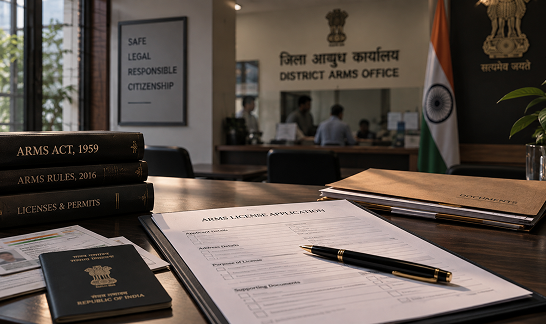
Owning a firearm in India legally starts with an arms licence. The process is governed by the Arms Act, 1959 and the Arms Rules, 2016, and most of it can now be started online. This guide walks you through eligibility, documents, each stage of the process, and what to do after approval.
In short: you apply through the NDAL-ALIS portal or your licensing authority, complete safety training, pass police verification, and wait for the authority’s decision. You can only buy a firearm only after your licence is approved.
Before you apply: understand your category
Firearms are classed as NPB or PB, and the category decides who issues your licence. Most civilians apply for NPB (Non-Prohibited Bore) licences at the district level. PB licences are handled centrally and granted only in special cases. Read our NPB vs PB guide first, so you know what you’re applying for.
Who is eligible?
Requirements are set by the Arms Act and Rules. In general you must:
- Be an Indian citizen and at least 21 years old.
- Have no disqualifying criminal record. Convictions for certain offences, or being of unsound mind, bar you from a licence.
- Show a genuine need or purpose, such as self-protection, sport or crop protection, as recognised by the Act.
- Pass police verification.
- Complete the arms safety training required under the Arms Rules, 2016.
The licensing authority has discretion, so meeting the basic criteria doesn’t guarantee approval.
Documents you’ll typically need
Exact requirements vary by district, so confirm with your licensing authority. Commonly asked documents include:
- Completed application form
- Proof of identity (Aadhaar, passport, voter ID)
- Proof of address
- Proof of age
- Recent passport-size photographs
- Medical fitness certificate, where required
- Safety training certificate, where required
- A statement or supporting documents explaining why you need the licence
- Details of the firearm type and bore you’re applying for
Keep scanned copies ready before you start the online application. The official guidance asks for PDFs of each document and a small JPG photograph, and notes that file-size limits apply.
Step-by-step: how to apply
Step 1: Decide the firearm type and category
Choose the type (pistol, revolver, rifle or shotgun) and calibre you want. Make sure it’s in a category you can apply for. Your application must name the weapon.
Step 2: Gather your documents
Prepare identity, address and age proofs, photographs and any supporting papers listed above.
Step 3: Register on NDAL-ALIS
Go to ndal-alis.gov.in, the Ministry of Home Affairs portal for arms licences. Create an account and keep your registration number safe. You’ll need it to track your application.
Step 4: Fill in and submit the application
Select the right licence category and licensing authority, fill in the online form, and upload your documents and photograph. Many authorities then ask you to print the signed application and submit it with your documents at their office. Check how your district handles this.
Step 5: Pay the fee
Fees depend on the licence type and authority, and are decided after your application is accepted. Pay only through the official portal or the authority’s official channels.
Step 6: Police verification
The licensing authority sends your application to the police for a background check. This usually covers your criminal record, address and character. Keep your address proofs and contact details ready, since officers may visit or call.
Step 7: Safety training
The Arms Rules, 2016 require applicants to complete an arms and ammunition safety training course. It covers safe handling and carry, firing techniques, care and storage of arms, key provisions of the law, and responsibilities, particularly around children.
Step 8: Decision by the licensing authority
The authority reviews your application, the police report and your stated need, then grants or refuses the licence. Secondary sources say the Rules set a 60-day decision period from a complete application, but timelines in practice can be longer, so keep following up through the portal.
Step 9: Receive your licence
If approved, you’ll receive your licence, which names the weapon type and bore you may acquire. It may also carry conditions.
Step 10: Buy from an authorised dealer
Only after approval can you buy your firearm, and only from a licensed dealer or manufacturer. The sale must be recorded on your licence. Buying or holding a firearm before your licence is issued is a serious offence.
How many firearms can you hold?
The Arms (Amendment) Act, 2019 reduced the maximum number of firearms one person can hold from three to two. Many licences are issued for a single firearm at the authority’s discretion. If you already hold a licence, check your own limit.
After you get your licence
- Validity: Licences are valid for a fixed period and then need renewal. Check the current validity period on the portal or your licence.
- Renewal: Apply well before expiry. Holding a firearm on an expired licence is illegal. Renewal can also be done through NDAL-ALIS.
- Verification: Recent amendments introduced periodic verification of licences and firearms. Follow any notices from your authority.
- Safe storage: Keep your firearm and ammunition locked and away from children.
- Carry rules: A licence to own is not automatically a licence to carry in public, and licence conditions apply. Read yours carefully.
- Changes: Report loss, theft, change of address or any other change to the authority as the rules require.
What if your application is refused?
If your application is refused, you should receive the reasons in writing. The Arms Act provides a right of appeal to the appellate authority within a set period, which is generally 30 days from the order. Confirm the exact period and procedure in the refusal order itself and consider speaking with a lawyer.
Common mistakes to avoid
- Applying for the wrong category. Check NPB vs PB before filing.
- Incomplete or mismatched documents. Names and addresses must match across proofs.
- Exaggerated or false statements. Be truthful about your needs. False claims can lead to rejection or legal action.
- Buying before the licence is issued. This is illegal.
- Trusting verbal assurances. Confirm with the official authority, not only a dealer or agent.
- Using middlemen who promise guaranteed approval. Approval is the authority’s decision, and nobody can promise it.